
Introduction to the Reducing-Balance Amortization Model
When you borrow money through a conventional home loan, auto loan, or personal bank loan, your repayment is almost universally structured as an Equated Monthly Installment (EMI) on a Reducing-Balance basis. Understanding how this calculation functions mathematically is essential for any borrower who wants to minimize total financing expenses.
In a reducing-balance loan, interest is calculated solely on the outstanding principal balance at the beginning of each billing month. Because each monthly payment partially reduces the remaining principal, the interest charge diminishes incrementally with every installment, allowing an increasing portion of your payment to extinguish the debt.
The Standard Reducing-Balance EMI Formula
The universal mathematical formula adopted by financial institutions worldwide is expressed as:
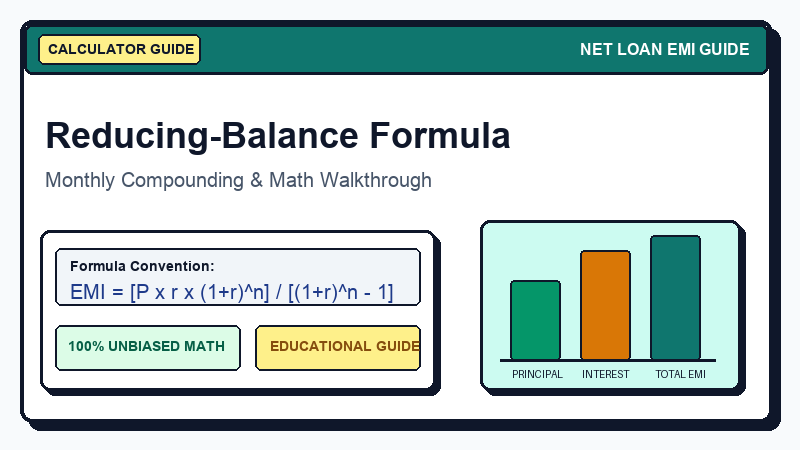
EMI = P × r × (1 + r)^n ÷ ((1 + r)^n - 1)
Where the mathematical variables represent:
- P (Principal): The total amount borrowed from the lender.
- r (Periodic Monthly Interest Rate): The stated annual interest rate divided by 12 months and divided by 100 to convert to a decimal:
r = Annual Rate ÷ (12 × 100). - n (Tenure in Months): The total number of monthly payments (Tenure in Years × 12).
Step-by-Step Numerical Example
To see how the mathematics unfolds in reality, let us walk through a representative personal loan scenario:
- Principal (P): $10,000
- Annual Interest Rate: 12.0% per annum
- Tenure (n): 12 Months (1 Year)
Step 1: Compute the Monthly Interest Rate (r)
Convert the annual rate into a monthly decimal fraction:
r = 12 ÷ (12 × 100) = 0.01 (or 1% per month)
Step 2: Compute the Compounding Factor (1 + r)^n
Raise (1 + 0.01) to the 12th power:
(1.01)^12 ≈ 1.12682503
Step 3: Solve the EMI Equation
Multiply the variables according to the formula:
Numerator = 10,000 × 0.01 × 1.12682503 = 112.682503
Denominator = 1.12682503 - 1 = 0.12682503
EMI = 112.682503 ÷ 0.12682503 = $888.49
Month-by-Month Amortization Walkthrough
Let us observe how the first three installments allocate funds between interest charges and principal reduction:
| Month | Opening Balance | EMI | Interest (1% of Balance) | Principal Repaid | Closing Balance |
|---|---|---|---|---|---|
| Month 1 | $10,000.00 | $888.49 | $100.00 | $788.49 | $9,211.51 |
| Month 2 | $9,211.51 | $888.49 | $92.12 | $796.37 | $8,415.14 |
| Month 3 | $8,415.14 | $888.49 | $84.15 | $804.34 | $7,610.80 |
Notice the trend: in Month 1, the interest was exactly $100.00. By Month 3, the monthly interest decreased to $84.15, while the portion of your payment reducing the actual debt grew from $788.49 to $804.34. Over a 15 or 30-year mortgage, this shifting ratio becomes dramatically pronounced.
Monthly Reducing vs. Daily Reducing Balance
While standard calculations apply monthly compounding, certain modern home loans calculate interest on a daily reducing balance. Under daily rest, interest is computed as: (Daily Balance × Annual Rate) ÷ 365. If you make payments or part-prepayments early in the calendar month, a daily reducing balance immediately reflects the savings, saving you slightly more interest than a monthly rest model.
How to Verify Your Lender's Figures
Whenever you receive a loan sanction letter, test the numbers using our interactive Loan EMI Calculator. If the lender's quoted monthly installment is higher than the calculated reducing-balance EMI for the identical interest rate and tenure, ask whether mandatory insurance or administrative fees have been embedded into your monthly installment.